How Do I Know Whether My Under-Eye Problem Is Pigmentation, Hollowing or Thin Skin?
Introduction
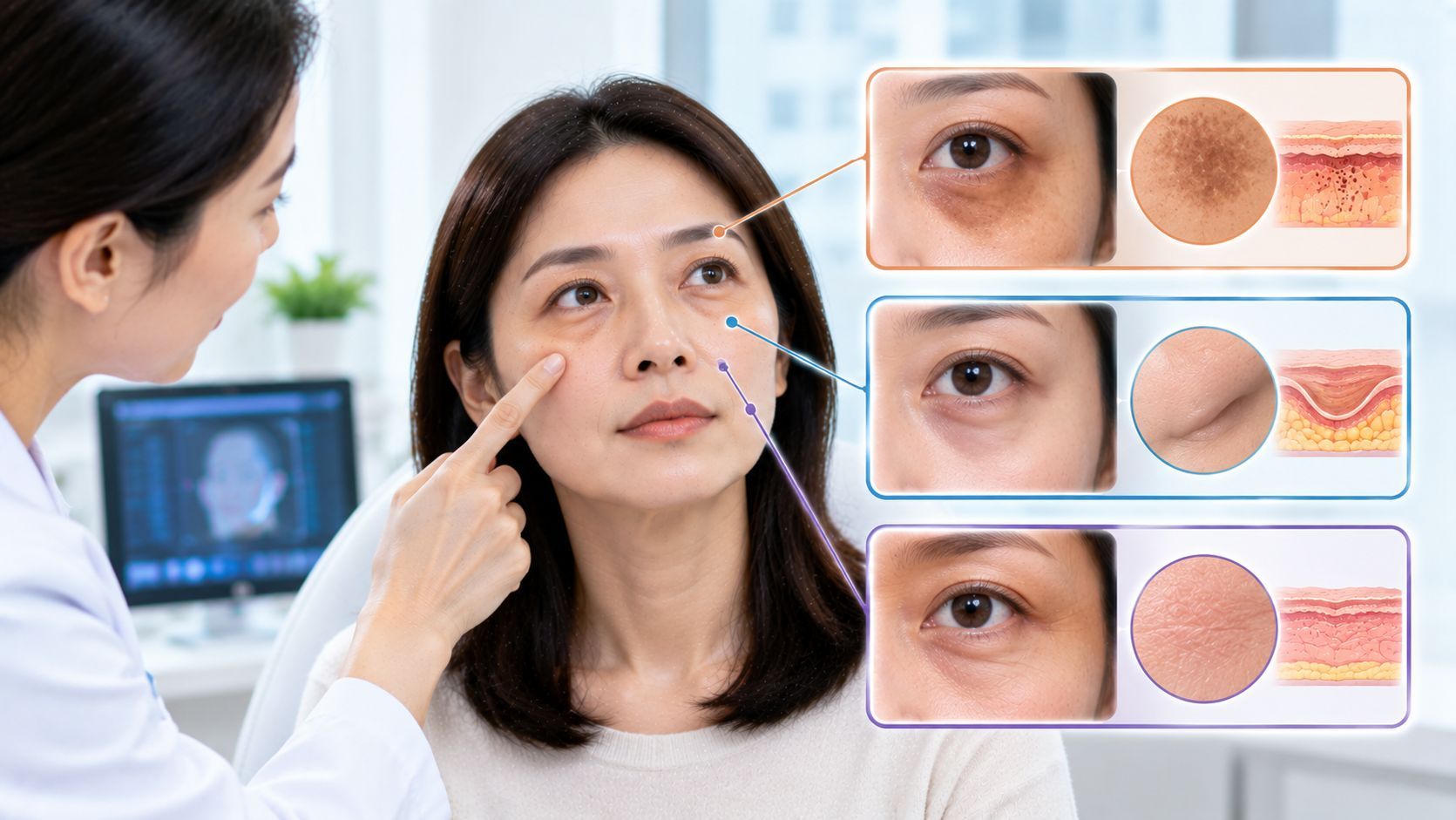
Dark circles can make the face look tired even when you are sleeping well. But “dark under-eyes” are not one single condition. The darkness may come from pigmentation, hollowing and shadowing, thin translucent skin, visible blood vessels, swelling, or a combination of several factors.
This distinction is important because the treatment categories are different. A pigment-focused treatment may help when excess melanin is the main problem, while it is unlikely to correct a deep tear trough. Similarly, adding volume does not necessarily improve genuine pigmentation.
If you are considering a Korean dermatology or aesthetic treatment, the first step should therefore be determining what is creating the darkness, rather than choosing a treatment simply because your under-eyes look dark.
What Causes Dark Circles Under the Eyes?
Medical literature describes several possible causes of infraorbital darkness, including:
- Excess pigmentation
- Thin, translucent lower-eyelid skin
- Visible vascular structures
- Tear-trough hollowing and shadowing
- Skin laxity and wrinkles
- Infraorbital fat changes
- Inflammation or post-inflammatory pigmentation
- Swelling
Multiple factors are present in many people.
A 2026 systematic review similarly describes infraorbital concerns as multifactorial, involving structural volume loss, pigmentation, vascular prominence, and skin laxity.
That is why two people can both say, “I have dark circles,” while needing completely different approaches.
Clues That Your Under-Eyes Are Mainly Pigmented
Pigmentation is more likely when the skin itself appears darker rather than the darkness being primarily created by a shadow.
Look for:
- Brown or brown-gray coloration.
- Darkness that remains relatively similar under different lighting.
- The color appears to follow the skin rather than a recessed contour.
- Both lower eyelids have relatively similar coloration.
- The area does not look dramatically different when you change your head position.
- You have a history of pigmentation, irritation, eczema, rubbing, or other inflammation around the eyes.
Periorbital hyperpigmentation can have genetic, constitutional, inflammatory, and other causes. Reviews also emphasize that skin irritation and allergic or atopic conditions can contribute to pigmentation around the eyes.
However, color alone is not enough to determine the cause.
Clues That Hollowing and Shadowing May Be the Main Problem
A tear trough or other structural depression can create a shadow that looks like pigmentation.
You may notice:
- A visible groove between the lower eyelid and cheek.
- The darkness is strongest in the recessed area.
- The color looks better in some lighting and much worse in overhead lighting.
- The under-eye appears darker when a light source comes from above.
- The problem is more obvious in photographs than in natural daylight.
- The cheek below the eye looks relatively flat or less supported.
Research specifically identifies shadowing from tear-trough anatomy as an important cause of infraorbital darkness.
One useful observation is to compare your face under front-facing light and overhead light. If the darkness changes dramatically with the direction of the light, shadowing may be contributing.
That does not prove that you have a tear trough, but it is a useful clue.
Clues That Thin Skin May Be Contributing
The lower eyelid has naturally thin skin, and in some people the skin becomes increasingly translucent or delicate.
Thin skin may contribute when:
- The under-eye looks almost bluish, purple, or gray rather than brown.
- Small blood vessels appear more visible.
- The skin looks very delicate or translucent.
- Fine lines are visible.
- The darkness becomes more noticeable as the skin becomes thinner with age.
- There is relatively little actual brown pigmentation.
A classic review of infraorbital dark circles identifies thin, translucent lower-eyelid skin over the underlying orbicularis muscle as one possible contributor.
This distinction matters because simply treating “darkness” as pigmentation may miss the underlying reason the area appears dark.
What About Visible Blood Vessels?
Not every blue or purple under-eye is pigmentation.
Vascular visibility can contribute to a darker appearance, particularly when the overlying skin is thin.
A vascular component may be more likely when:
- The color is bluish, purple, or reddish.
- The skin is particularly thin.
- The appearance changes with temperature or circulation.
- There is little obvious brown pigment.
- The darkness is visible even though the contour is relatively smooth.
Vascular and pigmentary causes can also coexist. Reviews classify dark circles according to pigmentary, vascular, structural, and shadowing mechanisms rather than treating them as a single condition.
A Simple Mirror Test: Color or Shadow?
You can make several observations at home before your consultation.
Look directly at the area in natural light
Ask yourself whether the skin actually looks darker or whether there is a visible depression producing a shadow.
Change the direction of the light
If the darkness changes substantially when the light moves, shadowing may be contributing.
Gently stretch the skin
If the apparent darkness becomes less obvious when the skin is gently stretched, both pigmentation and structural shadowing can still be involved, so this is not a diagnostic test.
Look at the color
Brown or brown-gray coloration can suggest pigmentation.
Blue, purple, or reddish coloration may suggest vascular visibility or thin skin.
Gray or dark areas can also result from shadowing.
Compare the two sides
Significant asymmetry may indicate differences in anatomy, pigmentation, vascularity, or previous inflammation.
What If I Have Pigmentation and Hollowing Together?
This is very common.
For example, you may have a mild tear trough creating a shadow while also having brown pigmentation in the lower-eyelid skin.
In that situation, treating only one component may produce incomplete improvement.
A systematic review of periorbital hyperpigmentation emphasizes that causes can be pigmentary, structural, vascular, or mixed, and that treatment should be selected according to the underlying cause.
This is particularly important if you are considering filler. Filler may address volume-related darkness, but it will not remove genuine pigmentation from the skin.
How Can You Distinguish Hollowing From Thin Skin?
This can be difficult without professional assessment.
A hollowing problem usually creates a contour change. You can see a depression or transition between the lower eyelid and cheek.
Thin skin is more of a surface and tissue-quality problem. The contour may be relatively normal, but the skin appears delicate and translucent.
You can potentially have both.
For example, an older face may have:
- A deeper tear trough
- Less midface volume
- Thinner lower-eyelid skin
- More visible vessels
- Some pigmentation
Together, these changes can produce much darker-looking under-eyes than any one factor alone.
What Treatments Correspond to Different Causes?
Main under-eye findingTreatment category that may be consideredPigmentationPigment-focused topical or procedural approachesVascular componentSelected vascular-targeting approachesHollowing/volume lossConservative volume-restoration evaluationThin, crepey skinSkin-quality or collagen-support approachesSignificant skin excessSurgical assessmentMultiple causesIndividualized combination approach
Evidence for treatment varies considerably by cause. A systematic review found that pigment-focused approaches such as topical agents and chemical peels may be useful for pigmentary dark circles, while lasers can have roles in selected pigmentary and vascular cases. Volume restoration is more relevant when volume loss is responsible for the appearance.
The quality of evidence is also variable, so treatment should not be chosen from a menu based solely on the word “dark circles.”
Why Filler Is Not Automatically the Answer
If the main problem is hollowing, volume restoration may be considered. But under-eye filler is an anatomically sensitive treatment.
The 2026 systematic review emphasizes the importance of patient-specific factors such as fat-pad anatomy, skin quality, and eyelid support when selecting treatments for infraorbital concerns.
If your problem is primarily pigmentation, filler does not address the pigment itself.
If your skin is very thin, adding volume may also require particularly careful assessment because the visible result depends on both the underlying contour and the quality of the overlying skin.
Therefore, “dark circles = filler” is an overly simple approach.
What If My Under-Eyes Look Worse When I Smile?
That can provide another clue, but it does not establish a diagnosis.
When you smile, the muscles around the eyes contract and the lower eyelid-cheek contour changes. This can make existing hollows, bags, wrinkles, or shadows more noticeable.
If the problem appears only or mainly during smiling, the treatment discussion may be different from someone who has constant pigmentation.
Take photographs with:
- A completely relaxed face
- A natural smile
- A slight smile
- Different lighting conditions
Showing these differences during a consultation can help the clinician understand what is static and what is dynamic.
How Should You Assess Your Under-Eyes Before a Korean Treatment?
If you are considering treatment in Seoul, focus on cause rather than product.
Ask the dermatologist:
- Is my darkness mainly pigment, shadow, vascular visibility, or thin skin?
- Do I actually have a tear trough?
- Is there genuine volume loss?
- How much of the problem is skin quality?
- Would treating pigmentation address the main problem?
- Would filler address the cause or only the shadow?
- Could an energy-based treatment help the skin quality?
- Do I have more than one contributing factor?
This is particularly useful if you want a subtle result. Treating a minor structural hollow aggressively when pigmentation is the dominant problem may not give the result you expect.
Why Skin Tone Matters
People with darker or more melanin-rich skin should receive particularly careful assessment before pigment-targeting procedures.
Periorbital hyperpigmentation occurs across skin types, and a 2024 systematic review specifically examined treatment considerations in Fitzpatrick skin types IV–VI.
Laser and peel treatments around the eyes require appropriate patient selection and technique because irritation or inflammation can potentially worsen pigmentation.
This is one reason an experienced clinician should determine whether the darkness is actually pigment before performing a pigment-targeting procedure.
Conclusion
The first step in treating dark under-eyes is identifying what is creating the darkness.
Brown discoloration may point toward pigmentation. A visible depression and lighting-dependent shadow may indicate hollowing. Bluish or purple coloration can be associated with visible vessels or thin skin. But these causes frequently overlap.
If you are considering Korean under-eye treatment, don't choose a procedure simply because you have “dark circles.” Have the clinician evaluate the color, contour, skin thickness, vascular visibility, and surrounding facial anatomy.
The right treatment category depends on which of those factors is actually responsible for your appearance.
FAQs
How can I tell if my dark circles are pigmentation?
Brown or brown-gray discoloration that remains visible even when lighting changes may suggest pigmentation. However, clinical assessment is needed because pigmentation can coexist with shadows and vascular factors.
How can I tell if I have tear-trough hollowing?
Look for a visible depression between the lower eyelid and cheek, particularly one that creates a shadow under certain lighting. A clinician can assess the contour more accurately.
Can thin skin cause dark circles?
Yes. Thin, translucent lower-eyelid skin can make underlying structures and blood vessels more visible, contributing to a darker appearance.
Will laser remove all types of dark circles?
No. Lasers may be useful for selected pigmentary or vascular causes, but they cannot correct every structural or volume-related cause.
Do dark circles always need filler?
No. Filler is primarily relevant when volume loss or hollowing contributes to the appearance. Pigmentation, thin skin, vascular visibility, and other causes require different considerations.
Can I have pigmentation and hollowing at the same time?
Yes. Mixed causes are common, which is why individualized assessment is important before choosing an under-eye procedure.