I Don't Remember Which Filler I Had Three Years Ago. Can I Still Get Skin Tightening?
Introduction
Yes, you may still be able to get a non-surgical skin-tightening treatment even if you do not remember which facial filler you received three years ago. However, an unknown filler history should be disclosed to the treating dermatologist rather than ignored.
The important issue is not simply how old the filler is. It is whether filler may still be present, where it is located, what material was used, and whether the planned energy-based treatment could overlap with that area.
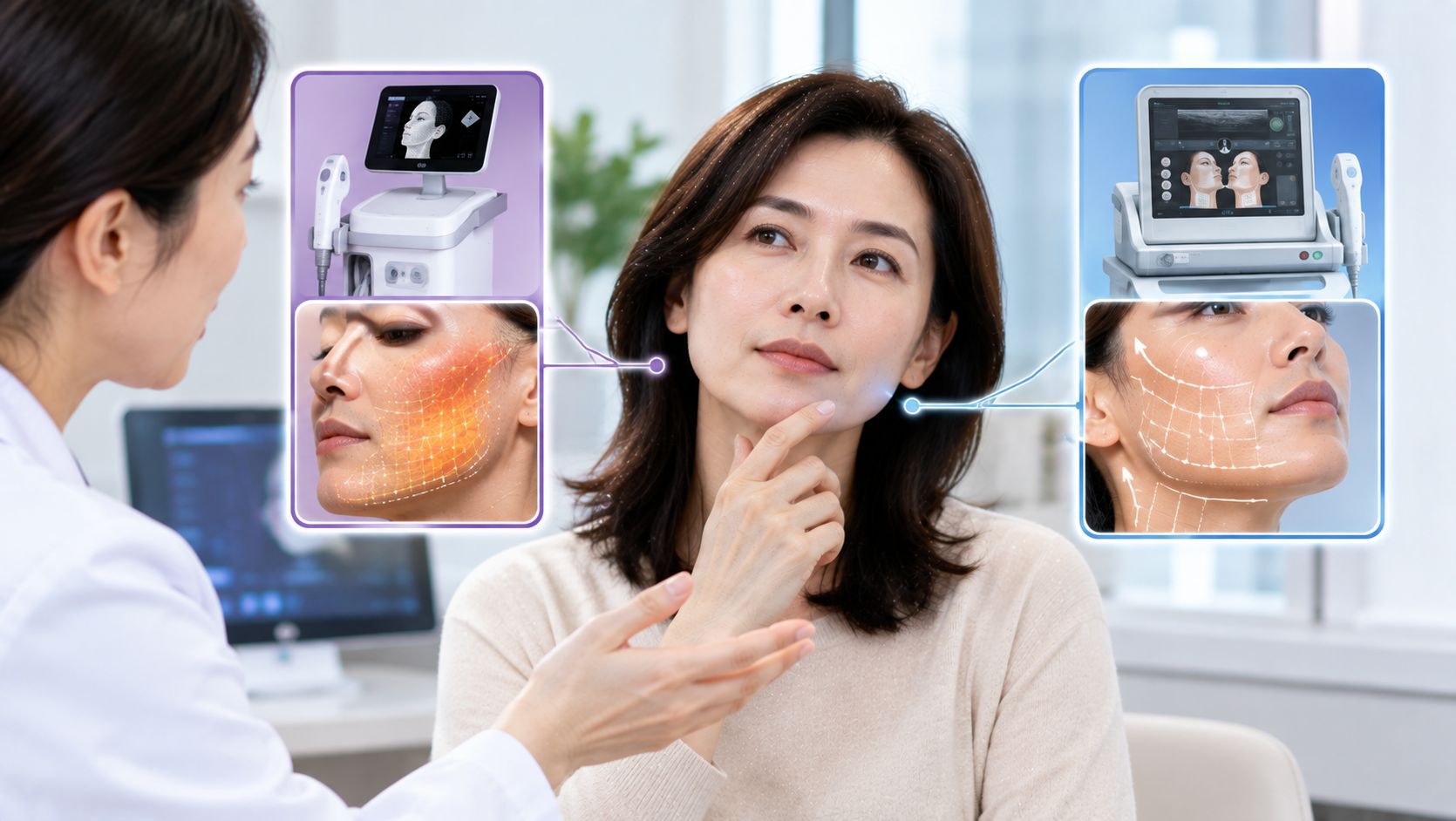
Thermage, Ultherapy, HIFU, Sofwave, and other energy-based treatments use different technologies and treatment depths. Therefore, the appropriate approach depends on the specific device and your facial anatomy rather than a universal rule about “old filler.”
Why Does the Filler Type Matter?
Different dermal fillers have different compositions and behaviors.
Common filler categories include:
- Hyaluronic acid (HA)
- Calcium hydroxylapatite (CaHA)
- Poly-L-lactic acid (PLLA)
- Polymethylmethacrylate (PMMA)
- Other biostimulatory or combination products
These materials cannot all be managed in the same way.
For example, hyaluronic acid filler can generally be treated with hyaluronidase when dissolution is medically appropriate. That does not mean every other filler can be removed using the same approach.
Knowing the filler type therefore gives your clinician useful information when planning subsequent procedures.
Does Three-Year-Old Filler Still Matter?
It can.
One of the most common assumptions patients make is that filler automatically disappears after its advertised duration.
In practice, persistence varies according to:
- Product characteristics
- Injection location
- Amount injected
- Individual factors
- Number of treatments
- Injection technique
Imaging studies have demonstrated that HA filler can sometimes remain detectable much longer than patients expect.
Therefore, three years is not enough information to conclude that no filler remains.
Can I Still Get Thermage?
Potentially, yes.
Thermage uses monopolar radiofrequency to deliver controlled thermal energy to tissue.
If you have previous filler, the clinician should determine whether the proposed treatment area overlaps the location of the filler and whether treatment parameters need to be modified.
You should not assume that having unknown filler automatically makes Thermage impossible.
At the same time, you should not assume that the filler is irrelevant simply because it was injected several years ago.
Can I Still Get Ultherapy or HIFU?
Potentially, but the same principle applies.
Ultherapy and other HIFU treatments use focused ultrasound energy at selected depths. The location of existing filler relative to the planned ultrasound treatment is therefore relevant.
If the filler location is unknown, your clinician may need additional information before deciding which areas and depths are appropriate.
A treatment plan should be based on the actual anatomy rather than simply the number of years since the filler was injected.
What About Sofwave?
Sofwave is another ultrasound-based skin-tightening technology, but its energy delivery and treatment characteristics differ from traditional HIFU systems.
Having previous filler does not automatically mean Sofwave is prohibited.
The clinician should still consider:
- Where the filler was placed
- Whether it may still be present
- The treatment area
- The tissue depth involved
- The patient's current facial anatomy
- Any history of filler-related swelling or lumps
This is why identifying the location of old filler can be more useful than simply knowing the brand.
What If I Have No Filler Records?
Don't panic.
You can start by giving the clinic everything you remember.
For example:
Approximate year: 2023
Area: Cheeks
Clinic: Previous aesthetic clinic
Product: Unknown
Approximate amount: Unknown
Other treatments: Botox, laser, or skin tightening if applicable
Even incomplete information can help.
If you have old photographs, receipts, treatment cards, emails, or medical records, bring them to your consultation.
Do not invent a filler brand simply because you remember what it looked like or because someone previously told you it was “a Korean filler.”
Could Ultrasound Identify the Old Filler?
In selected cases, yes.
High-frequency ultrasound can sometimes help identify retained filler deposits and their location.
This can be particularly useful when:
- The product is unknown
- Multiple fillers were previously injected
- Treatment records are unavailable
- There are persistent lumps
- There is unexplained swelling
- Facial asymmetry has developed
- The proposed treatment overlaps a previous injection site
Research has demonstrated that ultrasound can help visualize different filler materials and distinguish filler-related findings in appropriate clinical settings.
It is not necessarily required for everyone with an unknown filler history.
Should I Get an Ultrasound Before Skin Tightening?
Not necessarily.
The decision depends on your individual situation.
An ultrasound assessment may be more useful when you have:
- Multiple previous filler treatments
- Unknown injection locations
- Palpable lumps
- Persistent puffiness
- Significant contour changes
- Previous filler complications
- A planned treatment directly over a suspected filler deposit
If you had one small filler treatment several years ago, have no symptoms, and know exactly where it was injected, your clinician may determine that additional imaging is unnecessary.
What If My Face Looks Heavy Now?
This is an important reason to investigate the old filler rather than immediately adding a tightening treatment.
A heavy lower face or full cheek can result from:
Residual filler
Facial fat
Fluid retention
Skin laxity
Natural aging
A combination of these factors
For example, if the primary problem is excess filler volume, a skin-tightening treatment may not correct the heaviness.
Conversely, if the filler is satisfactory and the main issue is loose skin, dissolving the filler could unnecessarily reduce facial volume.
The goal should be to identify the cause before choosing the treatment.
Could Old Filler Be Responsible for New Puffiness?
It is possible, but puffiness has many potential causes.
Patients sometimes notice swelling around the eyes or cheeks years after filler. A clinician should determine whether the appearance is related to filler, normal anatomy, edema, inflammation, or another cause.
Persistent or newly developing swelling deserves assessment rather than automatically being attributed to aging.
If you have significant pain, redness, warmth, rapidly increasing swelling, skin discoloration, or other concerning symptoms, seek medical evaluation rather than proceeding directly with cosmetic treatment.
Should I Dissolve Unknown Filler Before Tightening?
Not automatically.
Dissolving an unknown filler without establishing what material is present can create additional uncertainty.
If the filler is HA, hyaluronidase may be an option when clinically appropriate. But if the filler is another material, a different management strategy may be necessary.
It is therefore better to determine whether there is a genuine reason to remove the filler before considering dissolution.
If the existing filler looks natural and is not causing problems, there may be no reason to remove it.
Can Skin Tightening Change the Appearance of Old Filler?
It can potentially change how the face looks without necessarily moving or destroying the filler.
For example, tightening surrounding skin may alter facial proportions and make existing volume appear more or less prominent.
Temporary swelling can also make the face look different during recovery.
Therefore, if you notice a change after treatment, it is important to distinguish:
- Temporary swelling
- Changes in skin tension
- Existing filler distribution
- Natural facial aging
- Actual filler-related changes
A single photograph taken under different lighting is not enough to establish what happened.
How Should I Prepare for Skin Tightening in Seoul?
If you are traveling to Seoul for a skin-tightening procedure, gather as much historical information as possible before your consultation.
Bring:
- Previous clinic records
- Filler receipts or treatment cards
- Product names, if available
- Approximate injection dates
- Injection locations
- Old photographs
- Information about previous dissolving treatments
- Details of other cosmetic procedures
If you cannot find the information, simply tell the Seoul clinic that the filler is unknown.
A transparent history is more useful than an inaccurate one.
Questions to Ask Your Korean Dermatologist
Before proceeding, consider asking:
- Can you determine whether filler is still present?
- Does my previous filler history affect the planned treatment?
- Do you need to know the exact filler brand?
- Does the treatment overlap my previous injection area?
- Would ultrasound imaging help?
- Should any treatment depth or area be modified?
- Is there any reason to dissolve the filler first?
- Is my current facial heaviness caused by laxity, volume, or something else?
- When should I assess the final tightening result?
These questions can help create a more individualized treatment plan.
When Should Skin Tightening Be Delayed?
A clinician may recommend additional assessment or postponement when there is an unresolved issue involving the previous filler.
Examples include:
- Unexplained swelling
- Painful nodules
- Rapidly changing lumps
- Significant inflammation
- Suspected infection
- Unclear anatomy in the treatment area
- Recent filler complications
Treating over an unresolved problem can make subsequent changes harder to interpret.
What If I Had Multiple Fillers Over the Years?
This situation requires even more careful planning.
If you have received filler repeatedly from different clinics, you may have more than one product remaining in different facial areas.
Your current facial appearance may therefore reflect a combination of:
- Previous filler
- Natural tissue
- Facial fat
- Skin laxity
- Aging
- Previous energy treatments
In such circumstances, an experienced clinician may consider examination and, when appropriate, ultrasound imaging before performing another treatment.
Conclusion
Not remembering which filler you had three years ago does not automatically mean you cannot get skin tightening.
However, the unknown filler should be disclosed. Three years is not necessarily long enough to assume that all filler has disappeared, and different filler materials require different considerations.
If you know the injection location but not the product, provide that information. If you have swelling, lumps, contour changes, multiple previous filler treatments, or an uncertain injection history, ultrasound may sometimes help identify retained filler and its location.
Most importantly, do not dissolve an unknown filler automatically. First determine whether it is actually contributing to the concern you want to correct.
For international patients traveling to Seoul, bringing previous treatment records, photographs, receipts, or treatment cards can make the consultation substantially more useful.
FAQs
Can I get skin tightening if I don't remember my filler brand?
Possibly. Not knowing the filler brand does not automatically prevent treatment, but your clinician should know that the product is unknown and may consider its location and other clinical factors.
Does three-year-old filler still matter?
Yes. Some fillers can persist longer than patients expect, so the age of the injection alone does not prove that no filler remains.
Should I get ultrasound before Thermage if my filler is unknown?
Not necessarily. Ultrasound may be useful when the filler location is uncertain, you have lumps or swelling, or the planned treatment directly overlaps the suspected filler.
Should I dissolve unknown filler before Ultherapy?
No automatic dissolution is necessary. First determine whether the filler is causing an unwanted problem and, when possible, identify what material was injected.
Can old filler make skin-tightening results look different?
Potentially. Changes in skin tightness, temporary swelling, facial aging, and existing filler volume can all influence how your face appears after treatment.
Can I get HIFU over old filler?
It may be possible depending on the filler location, depth, material, and HIFU treatment parameters. Your clinician should evaluate the relationship between the existing filler and planned treatment.