What's the Best Korean Treatment for Shaving-Related Pigmentation?
Introduction
Shaving-related pigmentation is common in men, particularly around the beard, jawline, neck, and upper lip. The darkening may look like a permanent beard shadow, but in many cases it is actually post-inflammatory hyperpigmentation (PIH) caused by repeated shaving irritation, razor bumps, ingrown hairs, or folliculitis.
This distinction matters because treating the pigment alone may not solve the problem. If shaving continues to trigger inflammation, new pigmentation can keep appearing.
For men considering treatment in Korea, the most appropriate approach often combines controlling the cause of the pigmentation with gradually treating the existing discoloration. If razor bumps or ingrown hairs are a major contributor, laser hair reduction may be particularly useful. Pigment-focused treatments may then be considered for discoloration that remains.
What Causes Pigmentation From Shaving?
Shaving itself does not necessarily cause pigmentation. The problem is usually what happens around shaving.
Common triggers include:
- Razor burn
- Repeated friction
- Ingrown hairs
- Razor bumps
- Folliculitis
- Picking or scratching bumps
- Shaving too closely
- Repeated inflammation around hair follicles
Pseudofolliculitis barbae, commonly called razor bumps, occurs when shaved hairs curve back toward or into the skin and trigger inflammation. It can lead to both hyperpigmentation and scarring, particularly in darker skin tones.
This means the dark areas around the beard may not simply be “pigment.” They can be the visible result of an ongoing hair-and-inflammation problem.
Is It Really Pigmentation or Just Beard Shadow?
Before choosing a Korean laser treatment, a dermatologist should determine what is creating the darker appearance.
True post-inflammatory hyperpigmentation
The skin itself has become darker after repeated inflammation.
This often appears as brown, gray-brown, or darker patches where razor bumps previously occurred.
Hair-related beard shadow
Dark hairs beneath the skin can create a gray or blue-gray appearance even when the skin is not significantly pigmented.
In this situation, a pigment laser may not address the main problem.
Active razor bumps
If there are still bumps, ingrown hairs, or folliculitis, treating pigmentation alone may be premature.
Mixed pigmentation and hair shadow
Some men have both. This is particularly common when coarse facial hair grows densely and shaving repeatedly causes irritation.
The treatment plan therefore depends on what the dermatologist sees during examination.
Could Laser Hair Removal Be the Best Treatment?
For men whose pigmentation is repeatedly triggered by shaving, laser hair reduction can be one of the most useful long-term strategies.
The reason is simple: it addresses the hair that is contributing to the cycle.
Laser hair removal targets pigment in the hair follicle. With repeated treatments, facial hair can become thinner and less dense, reducing the need for frequent shaving. The American Academy of Dermatology notes that men with persistent razor burn or ingrown hairs can use professional laser hair removal to substantially reduce or eliminate beard growth.
Research on pseudofolliculitis barbae also supports laser hair removal as a potential longer-term treatment, although treatment generally works best as part of a broader strategy that may include shaving modification and topical therapy.
This makes laser hair reduction particularly relevant when the pigmentation is being constantly recreated by shaving.
What If I Don't Want to Reduce My Beard?
Then laser hair removal may not be the right first choice.
Some men want to keep their beard density but simply reduce dark marks around the beard area. In that situation, a dermatologist may focus on:
- Reducing shaving irritation
- Managing ingrown hairs
- Treating active follicular inflammation
- Improving the skin barrier
- Using topical pigment treatments
- Considering a carefully selected pigment laser if appropriate
You do not necessarily need to remove your beard to improve shaving-related pigmentation.
What Korean Laser Treatments Can Be Used for the Pigmentation?
There is no single Korean laser that is automatically the best for every case.
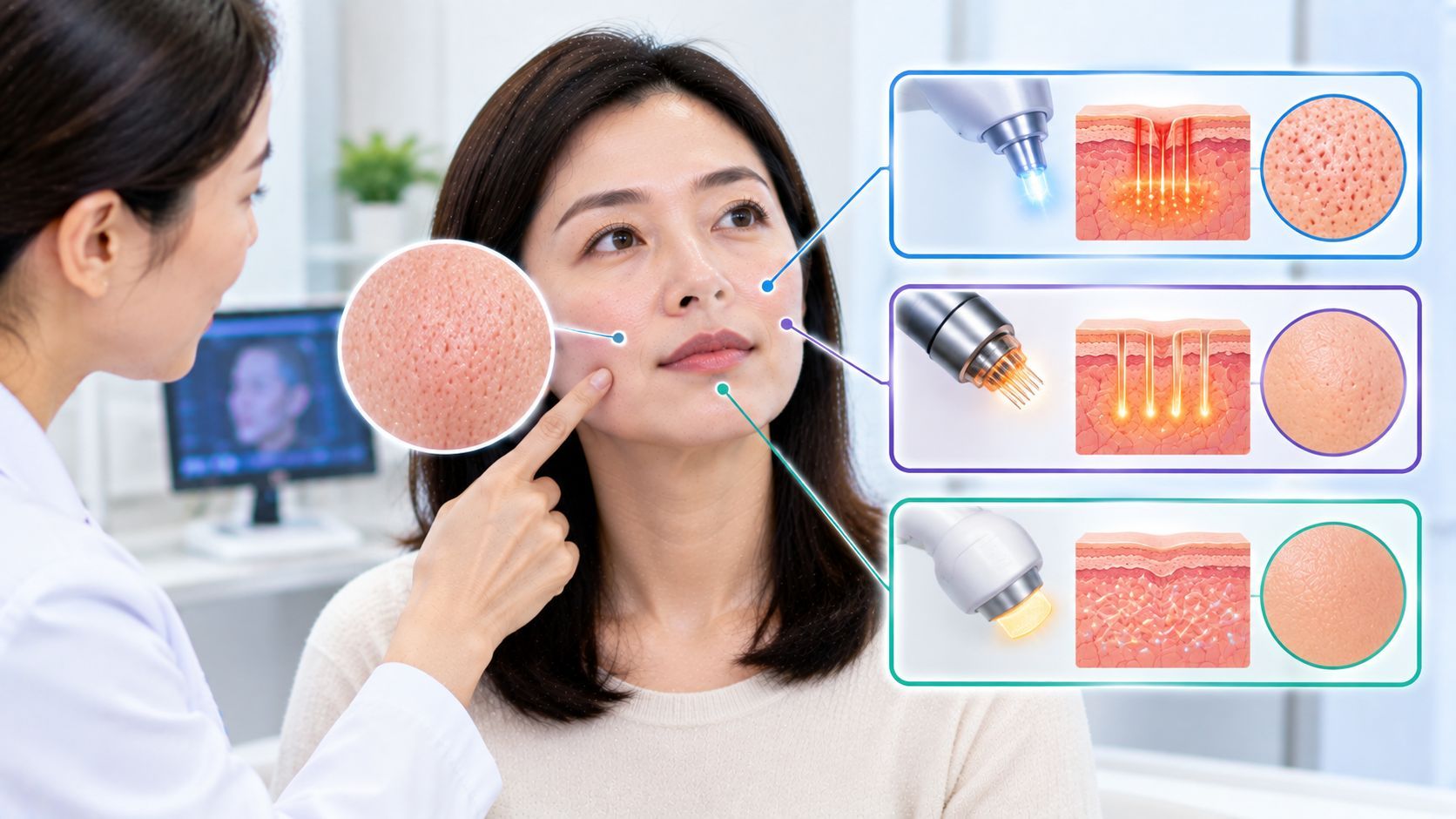
Depending on the type and depth of pigmentation, a dermatologist may consider different laser technologies, including Q-switched or picosecond Nd:YAG systems and selected fractional or other pigment-targeting approaches.
Recent dermatology literature emphasizes that laser treatment for pigmentary disorders in darker skin requires careful parameter selection because excess energy can itself trigger post-inflammatory hyperpigmentation. A 2026 clinical review specifically highlights conservative treatment strategies, appropriate device selection, and photoprotection for skin of color.
For PIH in skin of color, laser treatment is generally considered an adjunct rather than automatically the first treatment. A review of the literature found that topical approaches often remain first-line, with lasers considered when pigmentation is persistent or resistant.
Could Pico Laser Help Shaving-Related Pigmentation?
Possibly.
Picosecond lasers can be used for certain pigmentary conditions, but whether they are appropriate depends on the pigmentation's cause, depth, and the patient's skin type.
A common mistake is assuming that because a clinic offers Pico laser, every dark mark should be treated with it.
If the pigmentation is caused by continuing razor bumps, repeatedly treating the pigment without controlling the inflammation may produce disappointing results.
The underlying trigger should be addressed first.
What About Nd:YAG Laser?
Long-pulsed Nd:YAG laser has an additional role in men with darker skin who experience shaving-related problems.
Longer-wavelength lasers such as Nd:YAG have been studied for hair reduction in darker skin, with appropriate settings and cooling used to reduce unwanted effects. Research also suggests that reducing unwanted hair can improve pseudofolliculitis and associated discoloration.
A systematic review of hair-removal lasers in skin of color found that long-pulsed Nd:YAG had a favorable safety profile regarding post-inflammatory hyperpigmentation compared with IPL in the analyzed studies. However, laser selection should still be individualized rather than based solely on skin tone.
What If My Skin Is Darker or I Develop PIH Easily?
This is particularly important.
Darker skin contains more epidermal melanin, which can compete with the intended target of some laser treatments. This can increase the risk of unwanted pigmentation changes if treatment parameters are inappropriate.
If you develop dark marks easily after acne, cuts, shaving, or insect bites, tell the Korean dermatologist before treatment.
The doctor may consider:
- Your Fitzpatrick skin type
- Recent tanning
- Previous reactions to lasers
- Existing pigmentation
- Current inflammation
- Hair thickness and density
- Whether the target is hair, pigment, or both
- Conservative initial settings
- Appropriate cooling
- A test spot when clinically appropriate
A history of PIH does not automatically mean you cannot have laser treatment. It means the risk-benefit assessment becomes more important.
Should I Treat the Pigmentation Before Laser Hair Removal?
Not always.
If shaving is continuously producing new bumps and pigmentation, treating the hair problem may be an important part of stopping the cycle.
However, if the skin is currently inflamed or significantly irritated, the dermatologist may first want to calm the inflammation before performing an energy-based procedure.
The sequence can therefore vary.
For some men:
Control inflammation → reduce problematic hair growth → treat remaining pigmentation
For others:
Calm the skin → treat pigmentation → maintain results by changing shaving habits
There is no universal sequence for every patient.
Can Chemical Peels Help?
Selected chemical peels may be considered for superficial pigmentation, particularly when the skin also has uneven texture.
However, stronger does not mean better.
A peel that causes significant inflammation can potentially worsen PIH, especially in patients who already pigment easily.
The dermatologist should select the type, concentration, and treatment interval according to skin type and the specific pigment problem.
For darker skin, the evidence suggests that PIH treatment can be difficult and that no single modality reliably produces complete clearance in every patient.
What About Topical Treatments?
Topical treatment can be an important part of managing shaving-related pigmentation.
Depending on the diagnosis, a dermatologist may consider ingredients such as:
- Retinoids
- Azelaic acid
- Hydroquinone when appropriate
- Other pigment-regulating ingredients
- Anti-inflammatory treatments when active folliculitis is present
The specific choice depends on your skin, the severity of pigmentation, and whether inflammation is still active.
Importantly, topical treatment cannot prevent new pigmentation if shaving continues to cause significant inflammation.
How Can I Prevent New Pigmentation After Treatment?
Your shaving technique matters.
The AAD recommends measures such as avoiding excessively close shaving, using appropriate shaving products, and modifying shaving practices for men prone to razor bumps.
A dermatologist may recommend:
- Avoiding repeated passes over the same area
- Not shaving excessively close
- Using a suitable shaving lubricant
- Avoiding picking at ingrown hairs
- Allowing irritated skin to recover
- Considering an alternative hair-removal method
- Using daily sun protection
Sun exposure can also make existing pigmentation more noticeable and persistent, so photoprotection is an important part of pigment management.
What Should Men Ask a Korean Dermatologist?
If you are visiting Seoul specifically for shaving-related pigmentation, ask:
- Is this true pigmentation or mostly beard shadow?
- Are razor bumps causing the discoloration?
- Would reducing beard growth help prevent new pigmentation?
- What laser is appropriate for my skin tone?
- Am I at high risk of PIH?
- Should we treat inflammation before pigmentation?
- Would topical treatment be safer initially?
- Will this treatment reduce my beard density?
- How much downtime should I expect?
- What should I avoid before and after treatment?
These questions can help prevent choosing a laser simply because it is popular at a particular clinic.
What Is the Most Practical Treatment Strategy?
For many men, the answer is not a single procedure.
If razor bumps and ingrown hairs are driving the pigmentation, reducing the hair-related inflammation may be the most important step. Laser hair reduction can be particularly useful in this situation.
If the hair problem is controlled but brown or gray marks remain, a dermatologist may consider topical pigment treatment and, when appropriate, a carefully selected laser or other procedure.
If the skin is highly reactive or has a history of PIH, a more conservative approach may be appropriate.
The objective is not simply to make the beard area lighter as quickly as possible. It is to break the cycle that keeps producing pigmentation.
Conclusion
The best Korean treatment for shaving-related pigmentation depends on what is actually causing the dark appearance.
If repeated shaving, ingrown hairs, and razor bumps are responsible, laser hair reduction may be especially valuable because it addresses the underlying trigger rather than only treating the resulting pigment. If shaving is no longer causing inflammation but discoloration remains, topical treatment or a carefully selected pigment-focused procedure may be considered.
For men with darker skin or a strong tendency toward PIH, laser selection and treatment settings deserve particular attention. Current evidence supports cautious, individualized treatment rather than assuming that a more aggressive laser will produce faster or better results.
A Korean dermatology consultation should therefore begin with diagnosis: Is the darkness coming from pigment, hair, inflammation, or a combination of all three? Once that is established, the treatment plan becomes much more predictable.
FAQs
What is the best laser for shaving pigmentation in men?
There is no universally best laser. The appropriate device depends on whether the problem is PIH, beard shadow, ingrown hairs, or a combination. Nd:YAG and other pigment-targeting lasers may have roles in selected patients.
Can laser hair removal improve shaving-related dark marks?
It can help when razor bumps and ingrown hairs are contributing to the pigmentation because reducing hair growth can reduce repeated inflammation.
Can Pico laser remove shaving pigmentation?
It may help selected pigmentary conditions, but diagnosis and skin type are important. Treating the pigment without controlling ongoing razor irritation can limit the result.
Is laser safe for men with darker skin?
Laser treatment can be performed safely in darker skin when the appropriate device, settings, cooling, and expertise are used. However, darker skin has a higher risk of pigmentary complications, so treatment should be individualized.
Should I stop shaving before treating shaving-related pigmentation?
You may not need to stop completely, but modifying shaving technique can reduce new inflammation. If razor bumps are severe, a dermatologist may recommend changing the way you remove facial hair while treatment is underway.
Can shaving pigmentation disappear permanently?
It can improve substantially, but recurrence is possible if the underlying cause continues. Controlling razor bumps, ingrown hairs, and repeated inflammation is therefore an important part of maintaining improvement.