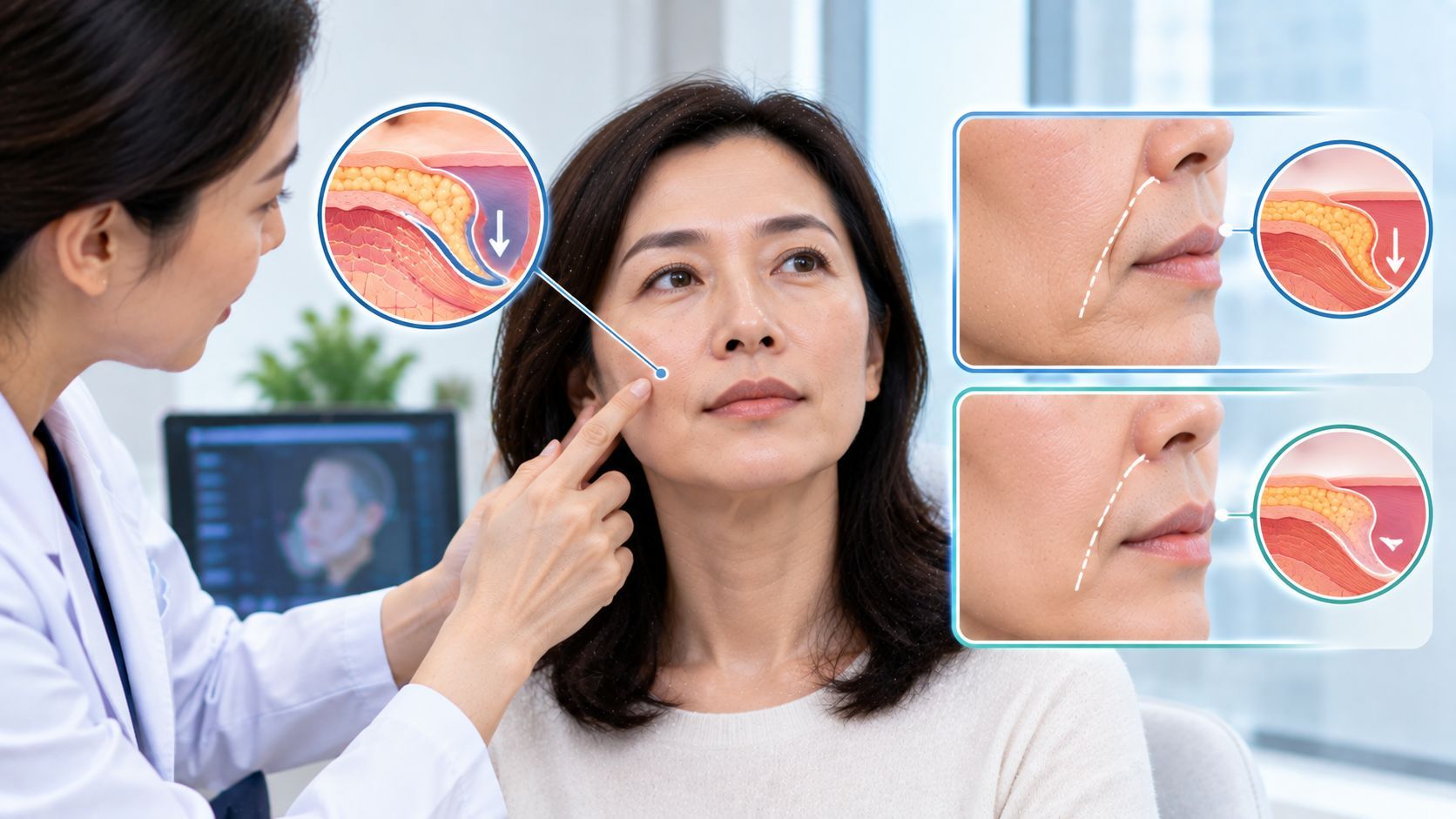
Can Ultherapy Affect Old Filler?
Introduction
Yes, Ultherapy can potentially interact with tissue containing old facial filler, but having previous filler does not automatically mean you cannot have Ultherapy. The important factors are the filler material, where it was injected, how much may remain, how long ago it was placed, and the depth and location of the ultrasound treatment.
Ultherapy uses microfocused ultrasound to create controlled thermal coagulation points at selected tissue depths. Because the treatment works beneath the skin rather than simply heating the surface, previous filler should be disclosed during consultation.
For someone considering Ultherapy in Seoul after previous filler, the safest planning approach is to determine what filler remains, where it is located, and whether the planned ultrasound treatment overlaps that area.
What Is Ultherapy?
Ultherapy is a non-invasive focused-ultrasound treatment designed to deliver controlled thermal energy beneath the skin. The treatment is intended to stimulate tissue remodeling and collagen production rather than add volume.
This makes it fundamentally different from dermal filler.
Filler: Adds volume or changes facial contours.
Ultherapy: Uses focused ultrasound energy to target selected tissue layers.
Because the mechanisms are different, having filler does not automatically make Ultherapy inappropriate.
However, the treatment depth matters. A clinician needs to understand the facial anatomy and the location of any existing filler before selecting treatment areas and settings.
Can Ultherapy Damage Old Filler?
There is not enough evidence to say that Ultherapy will always damage or always preserve every type of old filler.
The interaction depends partly on what the filler is made from.
Common facial filler materials include:
- Hyaluronic acid (HA)
- Calcium hydroxylapatite (CaHA)
- Poly-L-lactic acid (PLLA)
- Polymethylmethacrylate (PMMA)
- Other biostimulatory or combination materials
These products have different physical and biological characteristics.
Therefore, simply saying “I have filler” does not provide enough information for a clinician to predict how an energy-based treatment will interact with it.
What About Hyaluronic Acid Filler?
Hyaluronic acid is widely used for cheeks, lips, nasolabial folds, chin, jawline, and other areas.
If you have old HA filler, tell the clinician:
- The product name, if known
- Injection date
- Injection location
- Approximate amount
- Whether you have had touch-ups
- Whether you have experienced swelling or lumps
- Whether another clinic previously treated the area
One important issue is that “old filler” does not necessarily mean “completely gone.”
Some patients may still have detectable filler long after the expected duration of the product.
Ultrasound research has demonstrated that imaging can identify retained filler and distinguish different filler-related findings in some circumstances.
Can Ultherapy Make Old Filler Move?
There is no simple rule that Ultherapy will cause filler to migrate.
Filler migration is a separate clinical issue influenced by factors such as:
- Injection location
- Product characteristics
- Injection technique
- Tissue anatomy
- Previous procedures
- Time since injection
If your face already has an unusual contour, swelling, or palpable filler, it is better to investigate that issue before adding another treatment.
A change in appearance after Ultherapy does not automatically prove that filler has moved.
Temporary swelling, changes in skin tension, facial aging, and differences in lighting can all affect how an existing filler result appears.
Why Does Old Filler Matter More Than I Expected?
A common assumption is:
“I had filler several years ago, so it must be gone.”
That assumption is not always reliable.
Filler longevity varies considerably between products, anatomical locations, patients, and individual metabolism. Imaging studies have demonstrated that HA filler can sometimes remain detectable much longer than patients expect.
This matters if you are considering an energy-based procedure over the same facial region.
If you know exactly what was injected and where, treatment planning is easier. If your previous treatment history is unclear, additional assessment may be useful.
Could Ultherapy Change the Way My Face Looks Without Affecting the Filler?
Yes.
Suppose you have cheek filler and mild lower-face laxity.
Ultherapy may tighten selected tissue while the filler continues providing volume. The relationship between the skin, underlying tissue, and filler can therefore look different after treatment.
This does not necessarily mean that the filler was damaged.
The same issue can occur when facial aging changes around an old filler deposit. A filler result that once looked balanced may eventually appear too prominent or heavy because surrounding facial structures have changed.
What If My Face Already Looks Heavy From Old Filler?
This is an important situation to assess before choosing Ultherapy.
If the main issue is excessive or misplaced volume, skin tightening may not solve the underlying problem.
For example, someone might describe their face as:
- Heavy around the cheeks
- Bulky around the lower face
- Puffy underneath the eyes
- Wider than before
- Uneven after several rounds of filler
In such cases, the first step should be determining whether the appearance comes from:
Residual filler → the filler itself may be contributing to volume.
Edema → fluid retention or inflammation may be involved.
Fat → natural facial fat may contribute to fullness.
Skin laxity → loose skin may create a heavier appearance.
Combination → several factors may coexist.
Treating the wrong cause can lead to unnecessary procedures.
Should I Get an Ultrasound Before Ultherapy?
Not every patient with previous filler needs an ultrasound scan.
However, imaging can be particularly useful when:
- You do not remember the filler brand
- You have had multiple filler treatments
- You do not know exactly where the filler was injected
- You have persistent swelling
- You can feel lumps
- Your facial contour has changed unexpectedly
- You suspect residual or migrated filler
- You are planning another procedure in the same area
High-frequency ultrasound can sometimes identify filler deposits and provide information about their location relative to surrounding structures.
For international patients coming to Seoul, this can be especially helpful if previous treatment records are incomplete.
Should I Dissolve Old Filler Before Ultherapy?
Not automatically.
If your old filler looks natural, causes no problems, and remains appropriate for your facial structure, there may be no reason to dissolve it simply because you want Ultherapy.
Dissolving is a separate medical decision.
For HA filler, hyaluronidase can break down hyaluronic acid under appropriate medical supervision. But this does not apply in the same way to every filler material.
Therefore, before considering dissolution, determine what product was used whenever possible.
If your filler is causing unwanted fullness, persistent swelling, asymmetry, or other concerns, your clinician may recommend addressing the filler first rather than assuming Ultherapy will correct the problem.
What If I Had Filler Recently?
Recent filler deserves particular caution because the tissue may still be settling.
If you have significant:
- Swelling
- Bruising
- Tenderness
- Firmness
- Lumps
- Asymmetry
- Uncertain final contour
your clinician may recommend waiting until the situation has stabilized before performing additional procedures.
There is no universal waiting period that applies to every combination of filler and ultrasound treatment. The appropriate timing depends on the product, treatment area, clinical findings, and treatment plan.
What Should International Patients Do Before Ultherapy in Korea?
If you are traveling to Seoul for Ultherapy, prepare your previous treatment information before your appointment.
Bring:
- Filler product names
- Injection dates
- Treatment areas
- Approximate amounts
- Previous clinic records
- Before-and-after photographs
- Information about previous complications
- Details of other energy-based treatments
If you don't know the filler product, tell the clinic rather than guessing.
A qualified clinician can then determine whether further assessment, imaging, treatment modification, or simply careful treatment planning is appropriate.
When Should Ultherapy Be Postponed?
Your clinician may recommend delaying treatment if there is an unresolved issue in the planned treatment area.
Examples include:
- Unexplained facial swelling
- Active infection
- Significant inflammation
- Painful or rapidly changing lumps
- Uncertain anatomy requiring further assessment
- Very recent filler with substantial swelling
- A suspected filler complication
The priority should be understanding the underlying issue before adding another procedure.
What Questions Should I Ask My Clinic?
Before Ultherapy, consider asking:
- Can you identify where my old filler is located?
- Do you need to know the filler brand?
- Does the planned treatment overlap the filler?
- Which ultrasound depths will be used?
- Do you recommend imaging in my case?
- Should my existing filler be left alone or evaluated first?
- Could my current heaviness be caused by filler rather than laxity?
- When should I assess the final Ultherapy result?
These questions are particularly relevant when you have undergone multiple treatments at different clinics.
Conclusion
Ultherapy does not automatically become unsuitable simply because you have old facial filler. However, the location and type of filler matter, particularly when the planned ultrasound treatment will target nearby or overlapping tissue layers.
Old filler may also persist longer than expected, so the assumption that filler from several years ago has completely disappeared is not always reliable.
If you know your filler history and have no current complications, your clinician can plan treatment accordingly. If the product or location is unknown, or you have unexplained swelling, lumps, or facial heaviness, an assessment—and sometimes ultrasound imaging—may help clarify the situation before treatment.
For international patients visiting Seoul, bringing previous filler records and photographs can make the consultation much more useful.
FAQs
Can I get Ultherapy if I have old cheek filler?
Possibly. Previous cheek filler does not automatically rule out Ultherapy, but the clinician should evaluate the filler location, material, and planned ultrasound treatment depth.
Does Ultherapy melt hyaluronic acid filler?
It is not accurate to say that Ultherapy simply “melts” all HA filler. The interaction between energy-based treatments and filler depends on the specific treatment parameters, tissue location, and product characteristics.
Can Ultherapy move old filler?
There is no simple evidence that Ultherapy routinely causes facial filler to migrate. If you notice a contour change, other causes such as swelling, aging, or pre-existing filler distribution should also be considered.
Should I dissolve old filler before Ultherapy?
Not automatically. If the filler is satisfactory and there is no reason to remove it, dissolution may not be necessary. If the filler is causing unwanted volume or other problems, it should be assessed separately.
Is ultrasound imaging necessary before Ultherapy?
Not for everyone. It can be useful when the filler location or material is unknown, when there are lumps or swelling, or when previous treatment records are incomplete.
How long after filler can I get Ultherapy?
There is no universal interval for every patient. Your clinician should consider the filler type, treatment area, degree of swelling, and planned Ultherapy treatment before deciding on timing.