Should I Correct Facial Volume Before Tightening My Jawline?
Introduction
If your jawline looks less defined, it is natural to assume that the main problem is loose skin and that a tightening treatment should be the first step. However, jawline definition can be affected by several factors, including facial volume loss, sagging skin, jowls, bone structure, muscle size, and changes that occur with aging or weight loss. Because these factors can overlap, treating only the skin may not always address the reason the jawline has changed.
In some people, correcting facial volume before tightening the jawline may create a more balanced result. In others, tightening the skin first may be more appropriate. The right sequence depends on where volume has been lost, how much skin laxity is present, and what is creating the less-defined jawline.
Why Does Facial Volume Affect Jawline Definition?
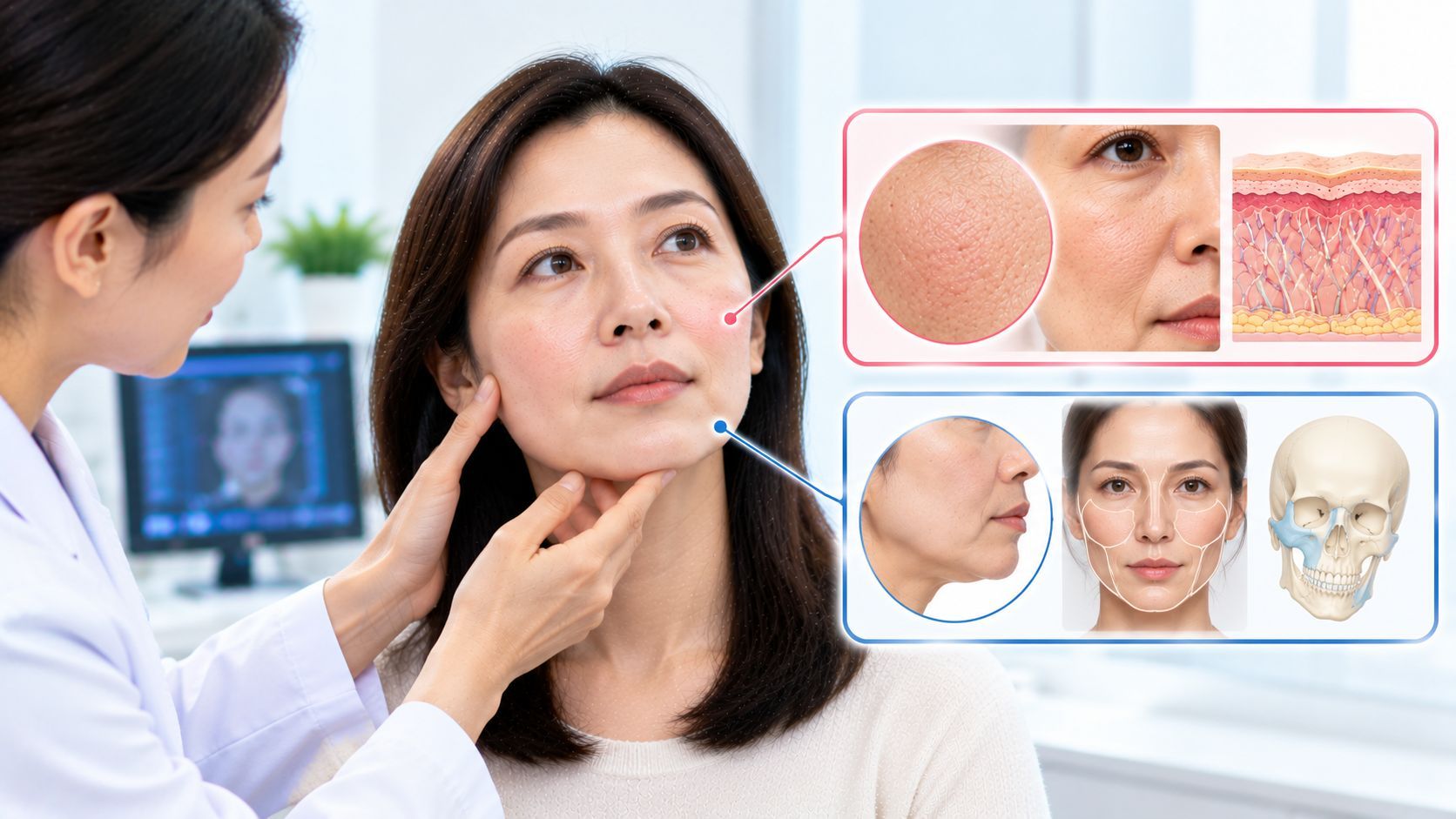
Facial volume is not simply about having a “full” or “thin” face. Fat compartments throughout the cheeks, temples, midface, and lower face contribute to facial proportions and support.
With aging or significant weight loss, some people experience volume loss in areas such as the cheeks and midface. At the same time, tissues can descend toward the lower face.
This combination may create:
- Less support in the cheeks
- A flatter midface
- More visible jowls
- A less defined mandibular contour
- A heavier-looking lower face
- A contrast between hollow upper areas and lax lower areas
If volume loss is a major part of the problem, simply tightening the skin may not restore the proportions of the face.
Does Volume Correction Need to Come Before Jawline Tightening?
Not necessarily.
There is no universal rule that facial volume must always be corrected before a tightening treatment. The sequence should be based on the underlying anatomy and the treatment being considered.
A dermatologist or qualified medical provider may consider volume correction first when the face appears noticeably depleted and the loss of support contributes to the appearance of jowls.
Conversely, tightening first may make more sense when the main concern is loose skin with relatively preserved facial volume.
In some cases, neither should be the immediate first step. For example, prominent masseter muscles, significant subcutaneous fat, or skeletal anatomy can influence the jawline and require a different treatment approach.
When Volume Correction May Be Considered First
Volume restoration may be discussed when the face has become noticeably hollow or flattened.
Common situations include:
Volume Loss After Weight Loss
Rapid or substantial weight loss can reduce facial fat volume. The resulting appearance may include hollow cheeks combined with looseness around the lower face and neck.
Adding volume does not necessarily tighten loose skin, but carefully restoring lost support can sometimes improve facial proportions.
Age-Related Midface Volume Loss
As the face ages, changes in fat distribution and soft-tissue support can contribute to a flatter cheek area and more noticeable lower-face laxity.
In selected patients, addressing volume loss may be part of an overall facial rejuvenation plan.
A Hollow Face With Mild Jowling
If the cheeks look significantly hollow while the jawline is only mildly loose, correcting proportions may be considered before aggressive tightening.
The objective is not to make the face larger. The goal is to determine whether insufficient volume is contributing to the overall appearance.
When Tightening May Come First
If facial volume is relatively well preserved and loose skin is the dominant issue, a tightening treatment may be considered first.
Depending on the patient and treatment area, options can include:
- Ultherapy or other focused ultrasound treatments
- Thermage
- Sofwave
- Other radiofrequency-based treatments
- RF microneedling in selected cases
- Other dermatologist-selected energy-based treatments
These treatments work differently and are not interchangeable. Some primarily target deeper tissue heating, while others address the dermis or combine microneedling with radiofrequency energy.
A consultation is important because the treatment that is appropriate for mild laxity may not be appropriate for substantial tissue descent or volume loss.
What If I Have Both Volume Loss and Loose Skin?
This is one of the situations where treatment sequencing becomes particularly important.
A person may have:
Volume loss + skin laxity + jowls
rather than simply “loose skin.”
In such cases, a clinician may create a staged plan rather than treating everything simultaneously.
For example, the plan could involve:
- Evaluating whether meaningful volume loss exists
- Determining whether the lower face actually needs tightening
- Addressing volume imbalance if appropriate
- Allowing the face to settle
- Reassessing the jawline
- Adding a tightening treatment if residual laxity remains
The exact order can vary depending on the treatment and the individual anatomy.
Why Over-Correcting Volume Can Be a Problem
More volume does not automatically mean a better jawline.
Adding excessive filler or another volumizing product can make the face appear heavier or alter facial proportions. This can be particularly important when the original concern is a wide or heavy lower face.
For patients who want a subtle result, the goal may be restoring selected areas rather than adding volume everywhere.
A consultation should therefore consider the entire face instead of treating the jawline in isolation.
What If My Jawline Is Wide Because of Muscle?
Not every broad jawline is caused by skin laxity or volume loss.
The masseter muscles can contribute significantly to lower-face width. Some patients may have a naturally broad mandibular structure, while others may have prominent masseter muscles.
In these situations, a skin-tightening procedure may not dramatically change the width of the jawline.
Masseter Botox is sometimes used to reduce masseter muscle activity and size, but it has different indications and considerations from skin tightening or facial-volume correction.
This is another reason why identifying the actual cause of the jawline concern matters before choosing a procedure.
Can Filler and Skin Tightening Be Done Together?
Sometimes, but the answer depends on the specific treatments and areas.
A clinician may recommend combining treatments during the same treatment plan, while in other cases they may prefer to separate them.
Factors that can influence the decision include:
- Which areas are being treated
- Type of filler or volumizing treatment
- Type of energy-based treatment
- Whether existing filler is present
- Degree of skin laxity
- Facial anatomy
- Previous procedures
- Desired degree of correction
If you already have filler in the cheeks, temples, jawline, or other areas, tell your provider before undergoing energy-based treatment.
What If I Already Have Old Filler?
Existing filler can change how a clinician approaches jawline tightening.
You may not know exactly where an older product remains or whether it has completely dissolved. Depending on the situation, the provider may review your treatment history and examine the area before deciding on another procedure.
In some circumstances, imaging may be considered, particularly when the location of previous filler is uncertain or when treatment planning requires additional information.
Do not assume that an old filler treatment is irrelevant simply because it was performed several years ago.
What About Skin Tightening After Weight Loss?
If your facial changes followed significant weight loss, the treatment sequence may be different from ordinary age-related laxity.
Weight loss can produce both:
- Reduced facial volume
- Increased visibility of loose skin
If additional weight loss is still expected, it may be useful to discuss whether facial treatment should wait until your weight is relatively stable.
Otherwise, further weight changes may alter facial volume and make the treatment result less predictable.
How Should International Patients Plan This in Seoul?
If you are traveling to Seoul for facial rejuvenation, avoid assuming that several procedures should automatically be performed during one appointment.
A better approach is to begin with an assessment of:
- Facial volume
- Skin laxity
- Jowls
- Masseter muscle prominence
- Existing filler
- Previous energy-based treatments
- Recent weight changes
- Your preferred level of correction
If volume correction is recommended, ask whether the jawline should be reassessed after the face has settled before adding a tightening procedure.
This can be especially useful if your goal is a subtle, natural-looking change rather than a dramatic transformation.
Questions to Ask Before Treatment
Before deciding whether to correct volume or tighten first, consider asking:
- Is my jawline problem mainly volume loss or skin laxity?
- Do I actually need additional facial volume?
- Could adding volume make my lower face look heavier?
- Would tightening alone address my concern?
- Do my masseter muscles contribute to my jaw width?
- Do I have existing filler that affects treatment planning?
- Should the treatments be separated?
- How long should I wait before reassessing the result?
- Would additional weight loss change the treatment plan?
Final Thoughts
Correcting facial volume before tightening the jawline can be appropriate when volume loss contributes significantly to facial imbalance, but it is not a universal rule. If loose skin is the primary concern, tightening may be considered first. If the jawline appears broad because of muscle or skeletal structure, a completely different strategy may be needed.
The most useful first step is therefore to determine what is actually causing the change in your jawline. Treating volume loss, laxity, muscle prominence, and facial structure as if they were the same problem can lead to an unnecessarily complicated treatment plan.
For patients seeking treatment in Seoul, a personalized assessment can help determine whether volume correction, skin tightening, another approach, or a staged combination makes the most sense for the individual's anatomy and goals.