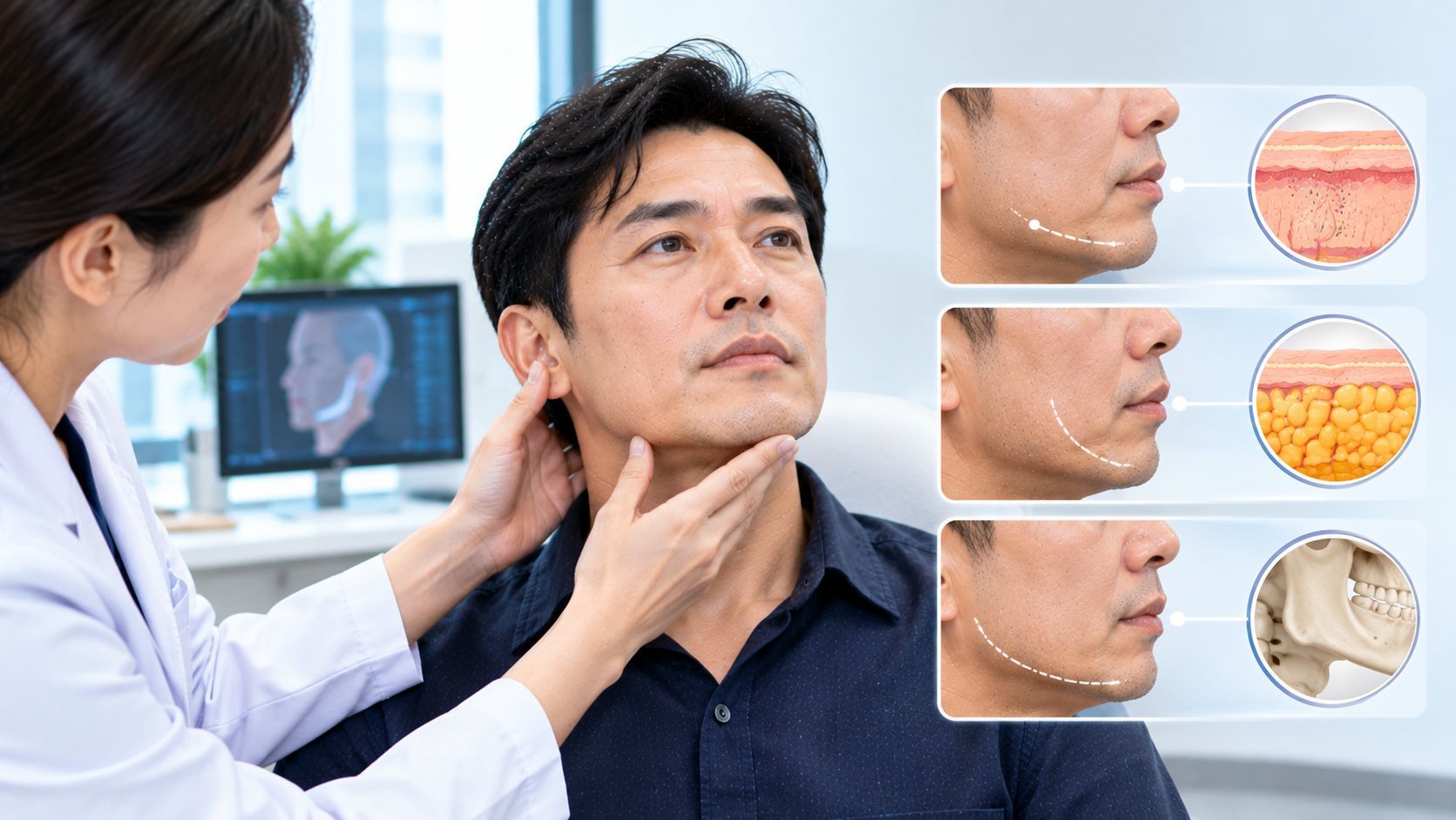
My Jawline Is Good but the Skin Underneath It Hangs. What Treatment Targets That?
Introduction
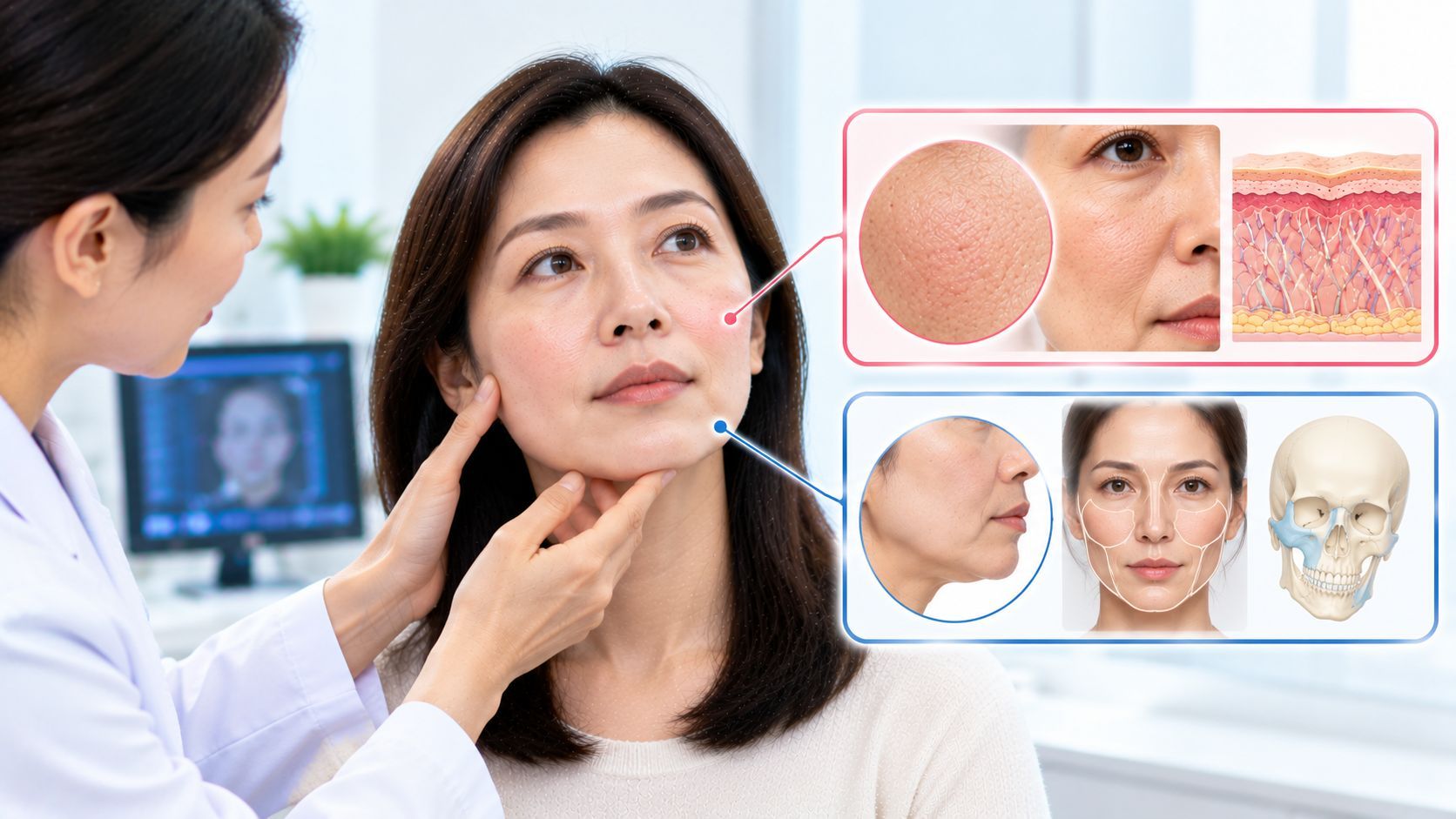
If your jawline itself looks well-defined but the skin underneath it hangs, the problem may be skin laxity rather than excess fat. This can happen with aging, weight loss, reduced collagen and elastin, genetics, or changes in the tissues that support the neck.
The appropriate treatment depends on how much loose skin is present. Mild laxity may improve with non-surgical skin-tightening treatments such as radiofrequency or ultrasound-based technologies. More significant excess skin may require a surgical approach because energy-based treatments cannot simply remove large amounts of loose tissue.
The first step is therefore to determine whether the hanging area is primarily loose skin, fat, muscle-related changes, or a combination.
Why Can Skin Hang Under a Good Jawline?
A defined jawline does not necessarily mean the neck skin underneath it will remain tight.
As we age, several changes can occur simultaneously:
- Collagen production decreases
- Elastin becomes less effective
- Skin becomes thinner
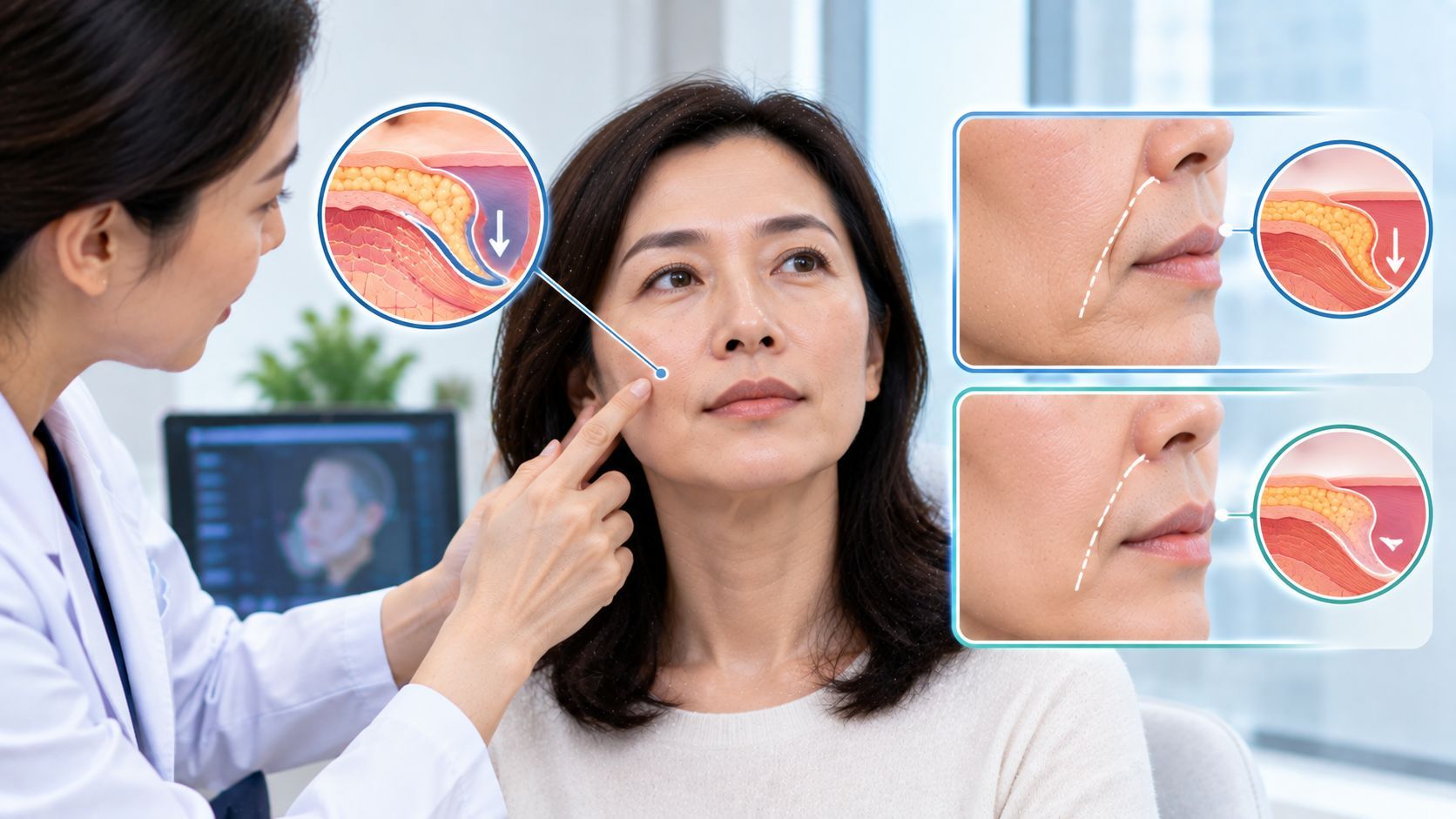
- Soft tissues gradually descend
- Fat distribution can change
- Neck muscles can become more visible
- The skin may lose its ability to retract after movement or weight changes
These changes can create a small fold beneath an otherwise attractive jawline.
Weight loss can also reveal laxity that was previously hidden by subcutaneous volume.
How Do I Know if It Is Loose Skin Rather Than Fat?
Loose skin and submental fat can look similar in photographs, but they are different problems.
Signs That Skin Laxity May Be the Main Issue
You may notice:
- Thin or crepey skin under the chin
- A small fold that becomes more obvious when you move your neck
- Hanging skin without much soft fullness underneath
- Wrinkling or fine horizontal lines
- More laxity after weight loss
- A relatively defined jawline above the hanging area
By contrast, submental fat usually creates a thicker, softer fullness beneath the chin.
Many people have both, so a clinical assessment is more useful than trying to identify the tissue from a photograph alone.
Why Does This Happen Even If I Am Thin?
Neck skin laxity is not necessarily related to body weight.
A slim person can have loose skin because of:
- Genetics
- Natural skin elasticity
- Aging
- Previous weight changes
- Sun exposure
- Changes in collagen and elastin
- Facial and neck anatomy
This is why losing additional weight is not necessarily the solution.
If the main problem is loose skin, further weight loss could potentially make the lack of soft-tissue support more noticeable.
Can Radiofrequency Tighten the Skin Under the Jaw?
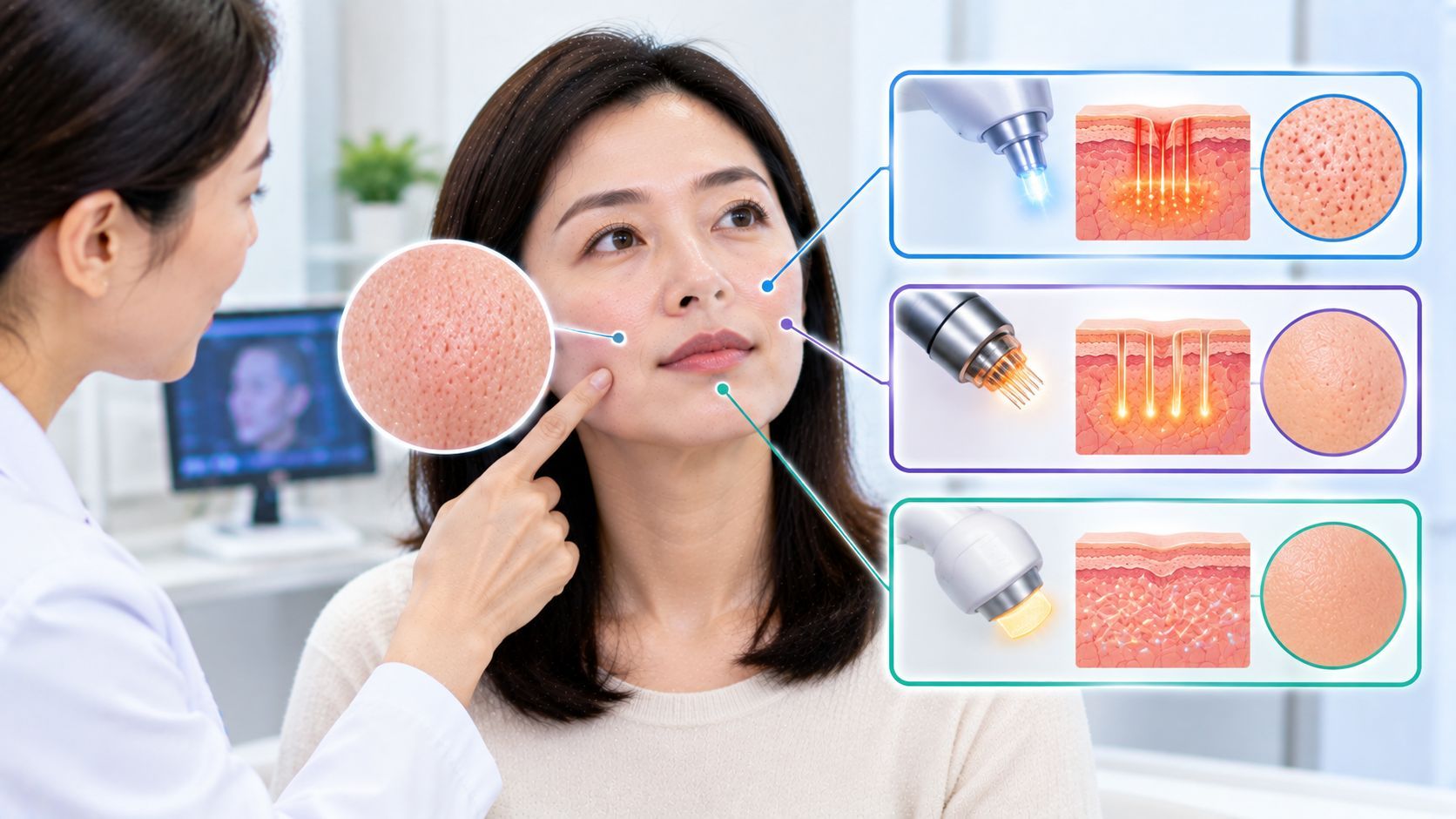
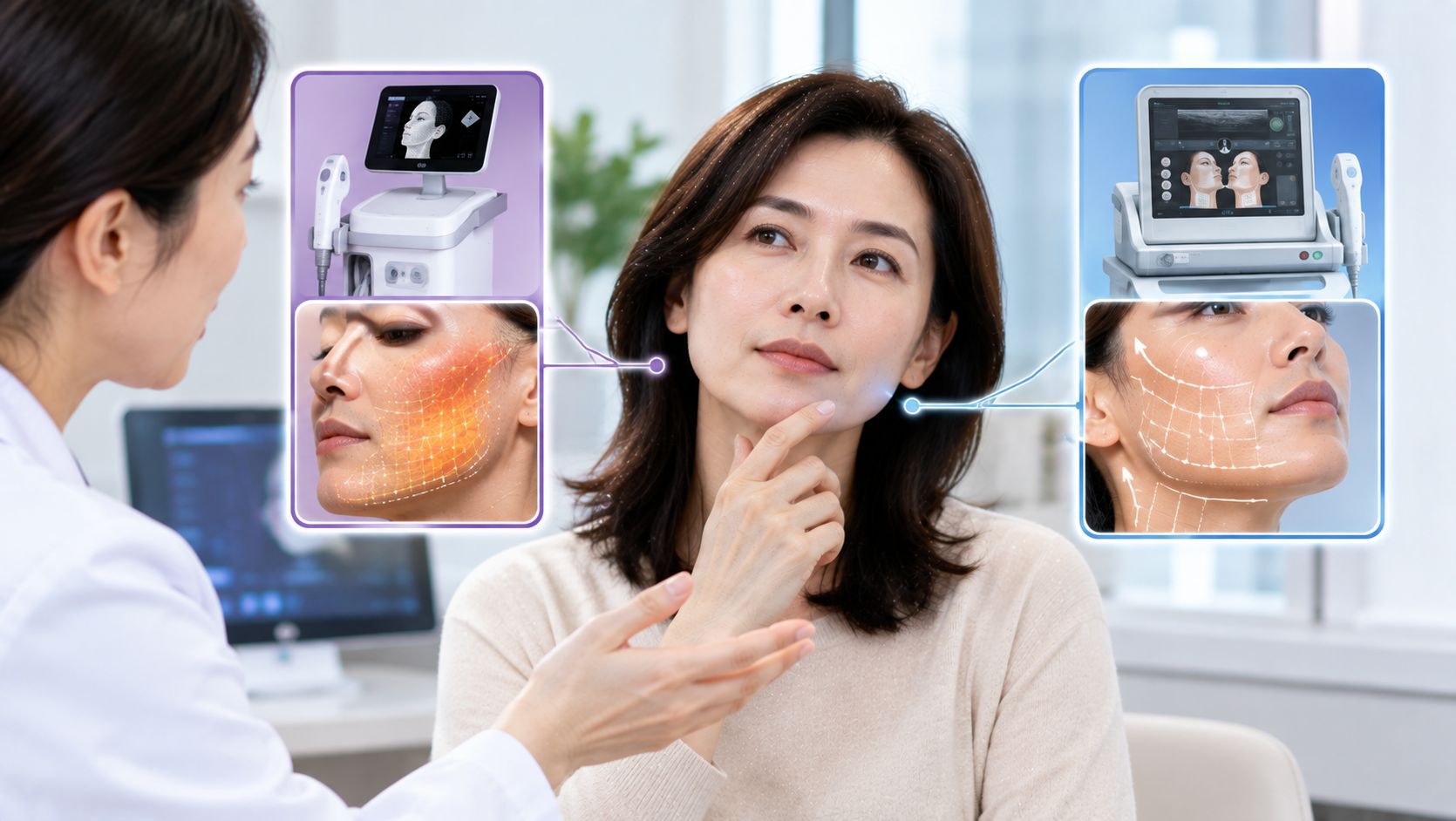
Radiofrequency (RF) treatments use controlled energy to heat tissue and can stimulate collagen remodeling.
For appropriate patients with mild to moderate laxity, RF-based treatments may improve:
- Skin firmness
- Mild sagging
- Texture
- Definition around the lower face and neck
Different RF technologies work at different tissue depths and use different delivery methods. Some are surface-based, while others deliver energy more deeply.
The expected result should be described as improvement, not a surgical lift.
RF cannot reliably remove a large amount of excess skin.
What About Thermage?
Thermage is a radiofrequency-based skin-tightening treatment used for various areas, including the face and neck.
It may be considered when the primary concern is mild skin laxity rather than substantial excess tissue.
The goal is generally gradual improvement rather than an immediate dramatic change.
Results vary depending on age, skin quality, degree of laxity, treatment settings and individual response.
If a large fold of skin hangs below the jaw, however, Thermage or another energy-based treatment may not provide enough correction by itself.
Can Ultherapy or Other Ultrasound Treatments Help?
Ultrasound-based lifting treatments can target deeper tissue layers and may stimulate collagen remodeling.
They may be considered when mild or moderate laxity contributes to loss of definition.
The important distinction is that ultrasound-based tightening does not physically remove excess skin.
If the neck skin is genuinely hanging because there is substantial redundant tissue, a tightening treatment may improve firmness without eliminating the fold completely.
What About Sofwave?
Sofwave uses a different ultrasound approach designed to heat a specific tissue layer and stimulate collagen remodeling.
It may be considered for patients with mild to moderate laxity who want a non-surgical option.
As with other energy-based treatments, results are generally gradual and variable.
The choice between RF, ultrasound and other technologies should depend on the patient's skin quality, laxity pattern, treatment history and goals rather than simply choosing a device by name.
Could RF Microneedling Help?
RF microneedling combines microneedling with radiofrequency energy.
It may be useful when skin texture and mild laxity are both concerns.
Potential treatment goals include:
- Improving skin texture
- Supporting collagen remodeling
- Reducing mild crepiness
- Improving firmness
However, RF microneedling is not a substitute for surgical skin removal when there is substantial excess skin.
It is more appropriate to think of it as a skin-quality and tightening treatment, not a neck lift.
What If the Hanging Skin Is Caused by Weight Loss?
Post-weight-loss neck laxity deserves particular attention.
After substantial weight loss, there may be less volume supporting the skin while the skin itself has limited ability to contract.
In this situation, repeatedly reducing remaining fat may not improve the contour.
A clinician may instead evaluate:
- Amount of remaining fat
- Degree of skin redundancy
- Skin elasticity
- Chin projection
- Neck anatomy
- Whether the weight has stabilized
If the jawline is already defined, preserving remaining volume may sometimes be more relevant than further fat reduction.
Can Botox Treat Hanging Skin Under the Jaw?
Botox is not a general treatment for loose skin.
It can be useful for selected muscle-related concerns, such as prominent platysmal bands or certain patterns of downward muscle pull.
But Botox does not remove excess skin or directly rebuild lost collagen.
If the primary problem is hanging skin, treating a muscle may not address the main cause.
A clinician should therefore determine whether muscle activity is actually contributing before considering Botox.
When Is Surgery More Appropriate?
Non-surgical treatments have limits.
If there is substantial excess skin, a surgical procedure may be more effective because surgery can directly remove and reposition tissue.
Depending on the anatomy, surgical options may include procedures designed to address the neck and lower face.
Surgery generally involves more downtime, preparation and risks than non-surgical treatment, so it should not be presented as necessary for mild laxity.
The important distinction is:
Mild laxity → tightening may be reasonable.
Significant excess skin → surgical assessment may be more appropriate.
Could My Chin Structure Be Making the Skin Look Worse?
Yes.
A recessed chin can make the transition between the chin and neck appear less defined.
In this situation, the skin may not actually be dramatically loose. Limited chin projection can simply make the neck appear fuller or less separated from the lower face.
This is why a proper profile assessment matters.
If the jawline is good from the front but the side profile appears weaker, chin projection may be one of the factors worth evaluating.
What Should I Consider Before Choosing a Treatment?
Before booking a treatment in Seoul, ask the clinic to identify exactly what is causing the hanging appearance.
Useful questions include:
- Is this primarily loose skin or submental fat?
- How much skin laxity do I actually have?
- Would RF or ultrasound tightening provide meaningful improvement?
- Is my chin projection contributing to the appearance?
- Would reducing fat make the skin more noticeable?
- Is RF microneedling appropriate for my skin quality?
- At what point would surgery provide a more predictable correction?
For international patients, it is also useful to ask about the expected recovery period and whether follow-up can be arranged after returning home.
How Can I Avoid Over-Treating the Neck?
The neck can be particularly sensitive to aggressive treatment because the desired result is usually subtle.
If your jawline is already well-defined, removing additional volume simply because the area under the chin looks loose may not be appropriate.
Likewise, using multiple tightening treatments without assessing the actual cause may add cost and recovery without addressing the primary problem.
A better approach is to identify the dominant issue and treat that tissue specifically.
Conclusion
If your jawline is already good but the skin underneath hangs, skin laxity may be the main concern rather than excess fat.
Mild to moderate laxity may sometimes improve with RF, ultrasound-based tightening, RF microneedling or other collagen-remodeling approaches. These treatments can improve firmness and texture but cannot reliably remove substantial excess skin.
If the laxity is significant, a surgical consultation may be more appropriate. And if the apparent fullness is partly caused by a recessed chin, improving chin projection may be relevant.
For patients considering treatment in Seoul, the most useful consultation is one that evaluates the entire jawline and neck rather than automatically treating the area as a double chin.
Frequently Asked Questions
Can skin under the jaw hang even if I have little fat?
Yes. Aging, genetics, weight loss and reduced skin elasticity can produce hanging skin even when there is little submental fat.
What is the best non-surgical treatment for loose skin under the chin?
There is no single treatment that is appropriate for everyone. RF, ultrasound-based tightening and RF microneedling may be considered for selected patients with mild to moderate laxity.
Can Thermage tighten loose neck skin?
Thermage may improve mild skin laxity and firmness, but substantial excess skin may require a surgical approach for more significant correction.
Can Ultherapy remove hanging neck skin?
No. Ultherapy is designed to stimulate tissue remodeling and tightening rather than physically remove excess skin.
Will losing more weight tighten my neck?
Not necessarily. If the problem is loose skin rather than excess fat, additional weight loss may not improve the hanging appearance and can sometimes make reduced soft-tissue volume more noticeable.
Can Botox fix loose skin under the jaw?
Botox does not directly tighten or remove loose skin. It may help selected muscle-related neck concerns, but it should not be considered a general treatment for skin laxity.